Comparison · Cooling choices
Air conditioning vs fans in a UK heatwave — what actually cools you.
Side-by-side comparison of what fans and AC each do, when WHO says fans stop working, and the sweet-spot combination that gives you comfort at the lowest energy bill.
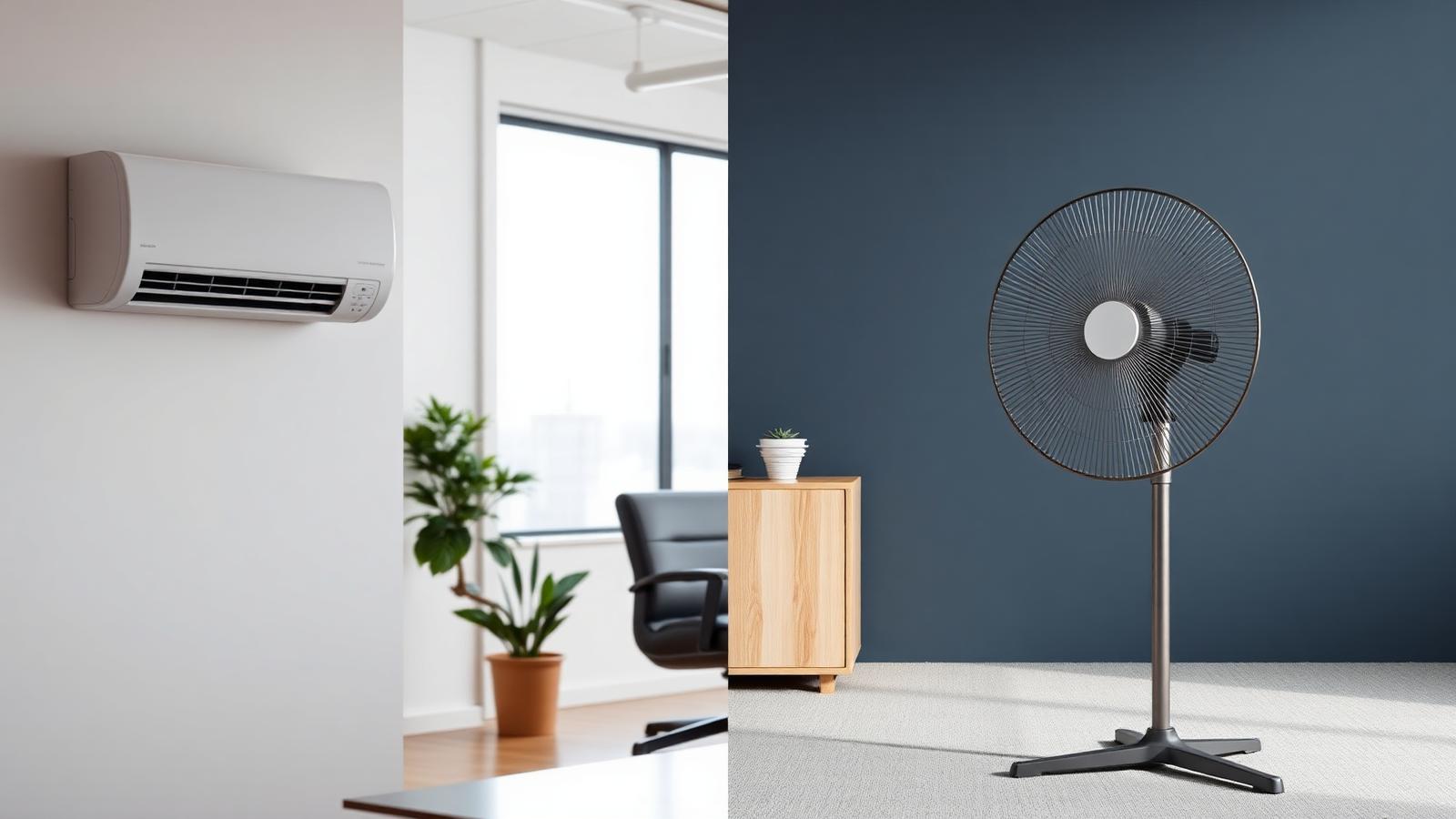
In short
Fans cool the person by evaporating sweat; AC cools the air by removing heat. WHO says fans stop giving useful cooling above 35 °C and can be harmful above 40 °C. For a healthy adult in a 28 °C room, a fan is fine. For a red Heat-Health Alert, or a vulnerable person, or a room above 30 °C, AC is materially safer and more effective — ideally set to 24–26 °C with a fan running alongside.
Side-by-side
The numbers behind each option.
| Attribute | Fan | Air conditioning |
|---|---|---|
| What it cools | The person (via sweat evaporation) | The air (by removing heat energy) |
| Effective up to | ~35 °C air temperature (WHO) | Any UK outdoor temperature |
| Dehumidifies | No — humidity unchanged | Yes — removes moisture from air |
| Filters air | No | Yes — pollen, dust, most PM2.5 |
| Running cost per hour | ~1–3p (30–100 W) | ~15–40p (1.5–4 kW) |
| Upfront cost | £25–£200 | £1,800–£4,500 installed (single room) |
| Vulnerable-user safety above 35 °C | Not recommended (WHO) | Recommended — reduces heat mortality |
| Overnight sleep quality | Marginal above 26 °C | Reliable below 26 °C |
Fan is enough when
A healthy adult, a mild-hot day.
- —Outside temperature is below 30 °C and inside is bearable
- —You're a healthy adult without cardiovascular conditions
- —You need personal cooling at a single desk or bedside
- —You're combining it with open windows for cross-ventilation
AC is the safer choice when
Red alert, vulnerable people, critical spaces.
- —Outside temperature is above 30 °C or UKHSA has issued an amber/red alert
- —The building houses older adults, young children or people with long-term conditions
- —You have server or comms equipment that must run at 18–27 °C
- —You need consistent comfort in an office where HSE thermal comfort duty applies
Related reading: keep cool in a UK heatwave, cool an office without AC, employer heat guidance, commercial AC cost guide.
Cooling FAQs
What people ask before buying a fan — or booking an AC install.
Do fans or air conditioning cool a room better?
Air conditioning cools the air itself — it removes heat energy from the room. Fans don't lower air temperature at all; they cool the person by moving air over skin, which speeds sweat evaporation. So a fan feels cooler in a warm room but the room stays the same temperature. For rooms above 30 °C, or for vulnerable people, air conditioning is materially more effective.
Are fans dangerous in a heatwave?
WHO and NHS guidance are consistent: fans give useful cooling below 35 °C air temperature but above 40 °C can accelerate dehydration by increasing sweat rate without lowering body temperature. For older adults and people with chronic conditions, fans alone above 35 °C are not recommended — that's the point at which mechanical cooling becomes the safer option.
How much does it cost to run air conditioning in the UK?
A modern inverter split-system AC unit draws 1.5–4 kW. At the current UK unit price (roughly 25p/kWh in 2026), that's 15–40p per hour of running. A typical UK bedroom AC unit run for 8 hours overnight costs £1.20–£3.20 per night. Modern inverter units are 30–50% more efficient than fixed-speed models from 10 years ago.
Can I use both a fan and air conditioning at once?
Yes — this is usually the most efficient setup. Set the AC to 24–26 °C rather than 20 °C, and use a ceiling or pedestal fan to move the cooled air. You get the same perceived comfort with roughly 30% less AC energy use, because the fan lets you accept a higher air temperature. Energy Saving Trust and CIBSE both endorse this pairing.
Do fans use less electricity than air conditioning?
Yes — by a factor of 30 to 100. A pedestal fan draws 30–100 W. An air conditioner draws 1.5–4 kW. That's why the practical answer is often to use both: AC to bring the room to a reasonable temperature (say 25 °C), then a fan to make it feel like 22 °C.
References
Sources for every claim on this page.
When a fan isn't enough